Central
Central
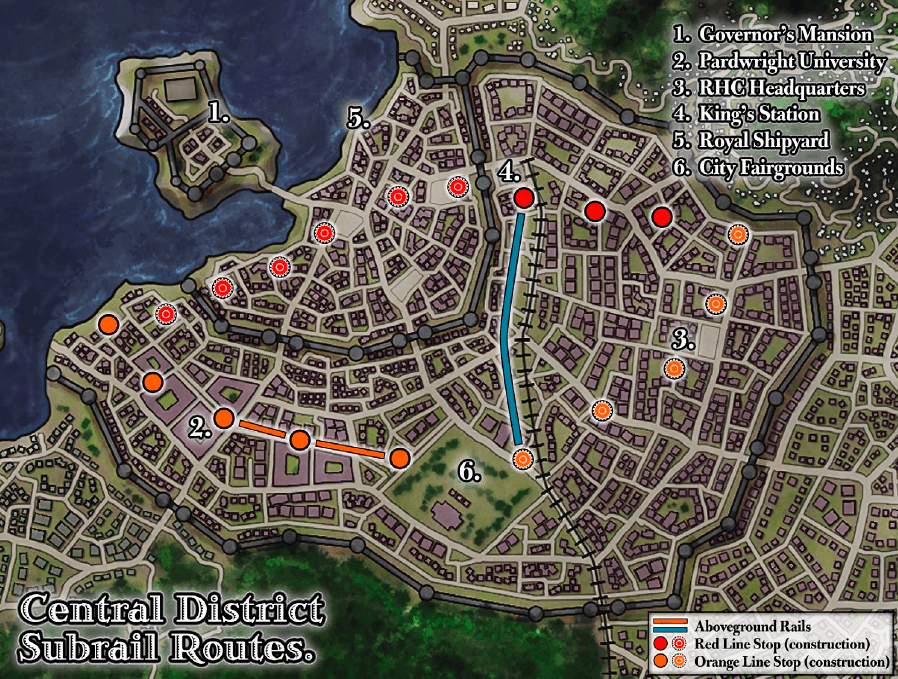
The oldest and most developed district of Flint is home to its main government structures, including the city council, superior court, police headquarters, and the offices of various civil functionaries like tax collectors. Grand party halls, ornate druidic garden temples, and parks filled with monuments to old wars provide recreation and entertainment for the city’s nobility and prospering middle class, while the Orange Street commodities market and the prestigious Pardwight University are the dual hearts of Flint’s economic and academic cultures.
The district mayor Oncala Putnam recently approved construction of a grand subrail station to serve as the hub of a city-wide transportation network. Currently the Central district is often clogged with traffic from the surface rail station, since the proposed tunnel through Humble Hill in the Nettles, meant to provide an easier route to the factories of Parity Lake, has been dogged by sabotage from elements opposed to the industrialization of Risur.
Just off the coast in Flint Bay, the city governor’s mansion occupies what was once an island fortress. For the past four hundred years the deva Roland Stanfield has, through vari- ous incarnations and with only rare disruption, served as city governor, earning near universal respect for his wisdom and leadership.
Perhaps most importantly for the PCs, Central district is home to the local headquarters of the Royal Homeland Constabulary, headed by Lady Inspectress Margaret Saxby. Extensive details of the local branch are presented in the page for the Royal Homeland Constabulary
Subrail Construction.
A major freight and passenger railroad line enters from the south and stops at King’s Station, but local light rail routes are being constructed throughout Central District. Most of this route travels underground, thus earning the moniker subrail. One section parallel to the freight line travels aboveground in the same corridor, and a brief stretch of track near Pardwight University rises to the surface by necessity, due to some magical quirks of geography.
The Navras Opera House
Flint’s oldest surviving building is the Navras Opera House in the central district. Navras, an eladrin who fled Elfaivar after the Great Malice, designed the opera house and laid the cornerstone with a brick he had brought from his homeland. He spent nearly two hundred years person- ally overseeing its construction, and was aided by no less than eight Risuri kings. When he completed the building, incongruously huge for what was at the time just a small river fort city, Navras gave the first performance by singing the dirge of Vekesh. As the audience cheered and wept at his performance, he walked off the stage and disappeared forever.
The acoustic design of the performance hall somehow captures magical power from song, or from the emotional reactions of the audience. Impresarios who coordinate performance almost always hire spellcast- ing bards to harness this energy and craft a magic item as a memento of the show. In the three hundred years since the Navras Opera House opened, most of these items have found their ways into private collections, but a rare few have become famous, such as the Hurricane Violin, which commemorated the Fable of Seaquen and later banished a sea monster that threatened Flint Harbor in 417 A.O.V.
