Elfaivar
Elfaivar
| Capital | Bharata (now Santi Simone) |
| Government | Feudal monarchy |
| Head of State | None |
| Language | Elven |
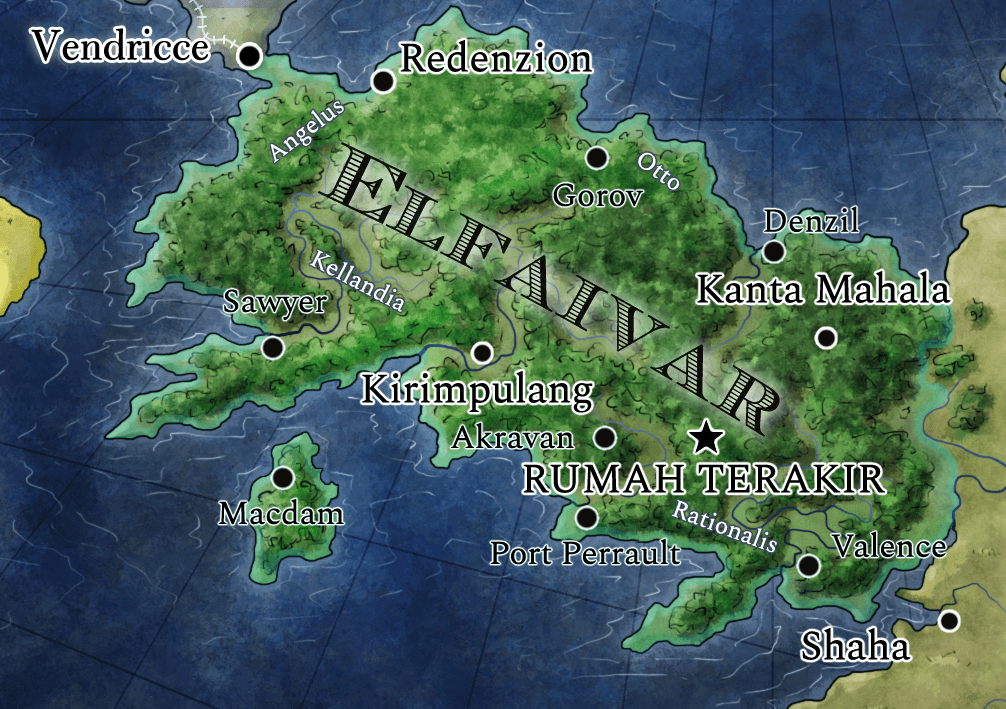
Before the Great Malice, the kings of Elfaivar held power to rival all the other nations of Lanjyr. Commanding vast armies and fielding battalions of fey mages and monsters, the long-lived eladrin monarchs were able to ensure the security and prosperity of the mightiest nation in the world.
Today, only ruins survive.
History
Malice Eternal
The Great Malice slew every eladrin woman in the empire and beyond, with only the rarest and most unlikely survivors: women currently polymorphed, on other planes, or who had forsaken the Elfaivaran faith entirely. Within weeks the once-glorious empire, which had been poised to crush the impudent Clergy who had twice launched a holy war against it, descended into chaos. Within decades the population had collapsed to the tiniest sliver of its original number.
A stirring eulogy from the poet Vekesh convinced a few eladrin to seek harmony, to endure, and to prosper—and above all else, to rebuild around whatever leadership remained so the race could heal. The eladrin women who had survived stepped into that vacuum as The Matriarchs, recognized rulers whose survival made them the political and spiritual heart of what was left of the nation.
For millions of grief-stricken eladrin men, the aftermath of the Great Malice was a time of constant, brutal battle simply to survive. Regional defense fell to sworn military orders, the Legions, formed around each surviving Matriarch's court and dedicated to her rule the way any nation's army swears loyalty to its head of state. These Legions became formidable fighting forces in their own right, and some held their ground against overwhelming odds rather than abandon the government they served.
Many eladrin men fled to other lands, seeking partners of other races, but they could sire no children. As attrition whittled down survivors, and too few children were born to keep society alive, the Legions poured what wealth and magical relics remained into defending their enclaves and the Matriarchs who governed them. When foreigners from Crisillyir or the distant east tried to claim Elfaivaran land they were driven back by fearsome eladrin warriors. Trained by constant battles for survival, and possessed of the finest arms and armor of entire cities, each man was the match for a hundred normal soldiers.
Eladrin are long-lived, but old age eventually claims even them. The Matriarchs' wisdom and spiritual strength extended the race's desperation, with pacts made with the powers of the Dreaming and other planes, but after two centuries, Elfaivar was practically a ghost nation. It took nearly a century more for Crisillyir and other nations to defeat the few vengeful hold-outs and begin to colonize the empty landscape.
Jungle had reclaimed cities. Mighty magical effects had lost their cohesion, spilling strange enchantments into the land. In some places the material world had blended and merged with the Dreaming. It was in these confusing borderlands that a handful of the original, Matriarch-led, Vekesh-inspired enclaves survived, their powerful Legions still standing guard over the lifeblood of their race.
Present
Modern Enclaves
Early on, the Matriarchs of the Vekesh-inspired enclaves consolidated real political and magical power, governing as the legitimate heads of state for what remained of their people. Daughters born into these enclaves are trained by the Matriarchs themselves in both statecraft and magic, preparing them to eventually lead enclaves of their own.
Despite the Legions' protection, foreign raiders have occasionally targeted the enclaves, hoping to capture or ransom a Matriarch. These attacks led to the first Vekeshi Retributions, as elite units of the Legion undertook daring missions to rescue an abducted Matriarch or, failing that, to visit absolute devastation on those responsible — a deterrent that's made such attacks rare.
In general, the enclaves stay hidden to protect their leadership. The Legions deploy spies to keep eyes on human activity in nearby lands and make bargains with fey to scare off those who get too close, realizing that open war with human nations risks the safety of the remaining populace.
A rare few eladrin men, often those exiled or unable to bear the burden of the Legion, seek to integrate with human society. They wear as much gold as they can, which prevents them from using fey step, in an effort to cut themselves off from their fey heritage and the pain of their dying race. By contrast, some Vekeshi mystics also adorn themselves in gold, but only as rituals of self-flagellation—a heavy, burning reminder of their distance from the Dreaming—so they can meditate on how best to reclaim their birthright and serve the Matriarchs more effectively.
The Fallen Goddess
Srasama was just one of dozens of prominent gods in the Elfaivar pantheon. Traditionally she was the six-armed sculptor who gave form to the raw creation discovered by her husband. She had dominion over the lives of women, and she particularly oversaw rituals of womanhood, marriage, and grief. For these, she would take three different forms of maiden, mother, and crone, but in all she was a fierce defender of the Elfaivar empire.
The famous adventurer Hamyd of the East claimed in the year 72 A.O.V. to have witnessed a conclave of eladrin matriarchs, wherein they performed the ancient rituals of Srasama. According to him, though, they cut short the rituals of the crone, and his guide alleged that this was because the matriarchs had forsworn grief, and so can never age.
Miscellanea
-
The Arsenal of Dhebisu: Eladrin tell a tale of a god who turned against their pantheon and was transformed into a tiger that walked like a man: a rakshasa. As a god, no weapon in the world could harm him, and he ravaged the lands of Elfaivar, drowning villages and tearing entire cities free from the earth with a swipe of his clawed hands.
A warrior named Dhebisu, infamous for her incongruous brilliance as a poet and lewd sense of humor, was called upon to defeat the rakshasa. She befriended the cats of the jungle to learn of the monster’s weakness, and consulted with sages to learn when the next meteor shower would occur. That night she sang a mocking tune to lure out the rakshasa.
The beast attacked her, but she pulled a falling star from the sky and wove it into her hair. Thenceforth any weapon she touched became infused with the powers of the heavens. They battled through the night, until finally, the rakshasa tried to slay her with a poisoned arrow. But Dhebisu snatched the bolt and plunged it into the fiend’s loins, destroying it so that it could never reincarnate.
