Lanjyr
Lanjyr
| Type | Planet |
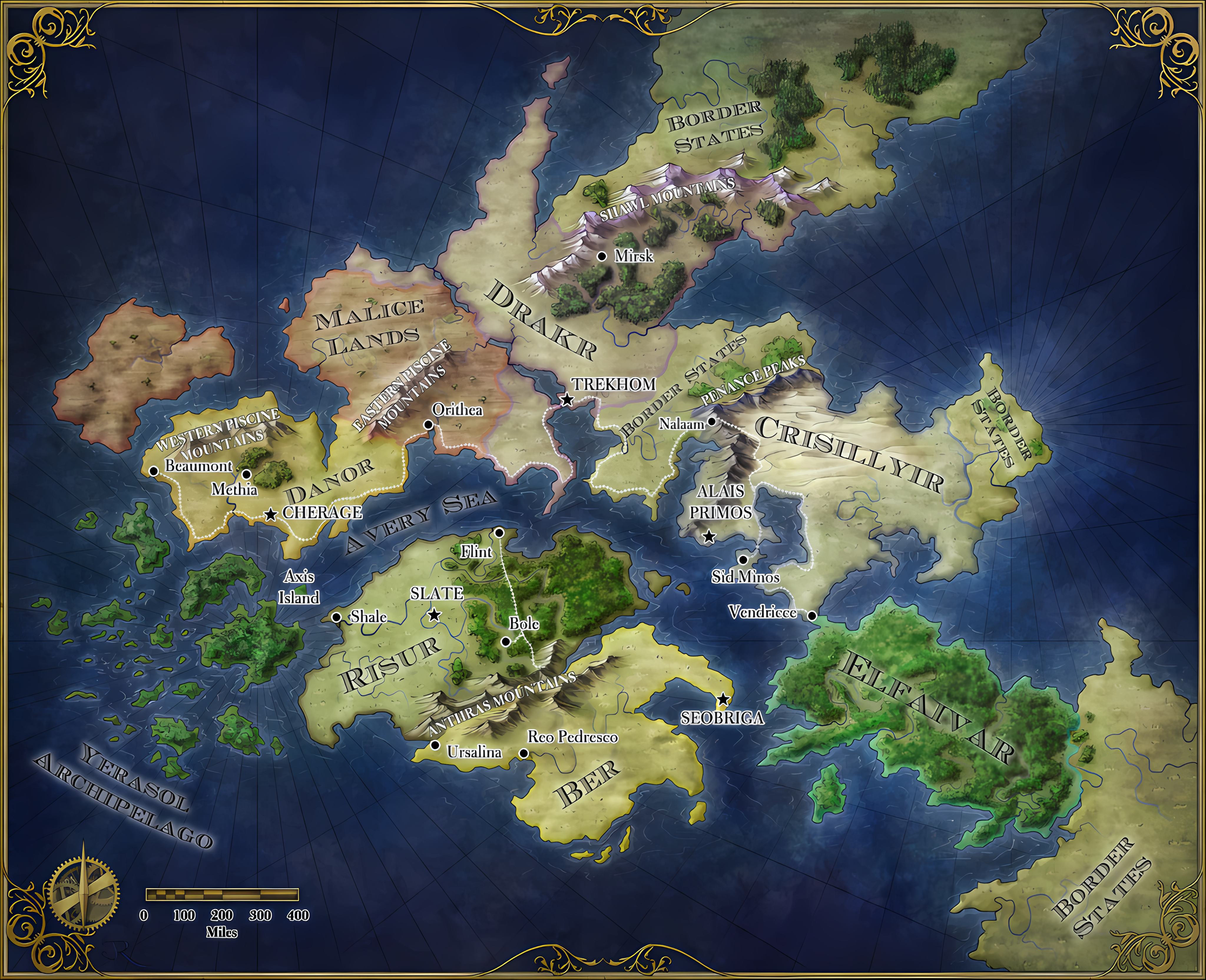
The world of the campaign, consisting of five major nations—Risur, Danor, Ber, Crisillyir, and Drakr—plus numerous weaker states, and the conquered eladrin Elfaivar Empire, now divided into many small colonies.
Regions
Major Powers
Border States and the Malice Lands
Risur, Ber, Crisillyir, Danor, Drakr, and Elfaivar are the largest and most prominent nations in Lanjyr, but by no means are they the only ones.
Other areas surrounding Danor are called the Malice Lands. When Danor had its magic stripped away during the Great Malice, these lands were at the edge of the effect’s radius. The magic there was left fractured and unstable. While Danor was able to restore itself in the relative stability of its dead magic zone, the wild magic of the Malice Lands has led to irregular catastrophes and small cataclysms that tend to wipe out any nation that tries to establish itself there.
Most people in the Malice Lands live in small villages or as nomads in order to avoid the more deadly manifestations of this wild magic. These war-torn lands tend to become havens for criminals who cross into their neighboring countries to pillage and plunder. One noteworthy exception is the city-state of Orithea, which has managed to prosper in a small pocket of stable, albeit weakened magic.
In general, the border states between Risur and Ber are little more than mountainous tribal lands that refuse to join either larger nation. The border states between Crisillyir and Drakr are fairly autonomous and stable, while the border between Drakr and Danor is near anarchy. North of Drakr, a few minor nations stay out of the politics of greater Lanjyr, while beyond Elfaivar lie powerful protectorates of a distant empire, still recovering from the fall-out of the collapse of Elfaivar centuries ago.
Items of Note
Calendar
The region generally uses a simple calendar devised over a millennium ago by the skyseers of Risur. This calendar divides the year into four 91-day seasons, each starting on an equinox or solstice. After the 91st of Winter, one extra day is used to celebrate the new year.
The most common celestial rhythm is the cycle of the moon over 29 and a half days. People might say something happened “a month ago,” but individual months are not named. Instead dates are referenced in the format “17 Spring 473 A.O.V.”
In the year 500 A.O.V., the first first-quarter moon of each season occur on 12 Spring, 10 Summer, 9 Autumn, and 7 Winter. Festivals of the Old Faith typically fall on these nights. More colloquially, there are names for each prominent moon phase throughout the year. These terms have fallen out of favor except in poetry, academia, and mysticism
Lunar Myth
Some say the moon is made of glass, and they claim they can see stars through it, or perhaps within it. Poets have long noted that the “right side” of the moon (the edge that crests the horizon first) seems to have the shape of a man with his arms extended, while the left side has the image of a woman facing away from the man. This gave rise to a shared myth of the moon.
In this tale, an orphan boy meets a girl whose mother is dying beneath a cypress tree. The girl is taken away to be trained as a mage (or an artist, a princess, or a scholar depending on the version), and the orphan boy joins a band of hunters (or rogues, brigands, or rebels). They cross paths, fall in love through their trials, wed, and become heroes. But he dies, and she lives on to raise their child.
Though different seasons can have more specific names, generally the first quarter moon—when only the “man” is visible—is called Hunter’s moon. The full moon is Lovers’ moon—when both man and woman are present. The third quarter is Maiden’s moon—with the woman alone. And the new moon is Dreamer’s moon.
Much of the nuance of Skyseer prophecy depends on which moon rises first in a season, and which stars if any are in conjunction with it. The specialized names typically start with the first Hunter’s moon each season; phases before those are just called by the generic terms of “early Lovers, early Maiden, or early Dreamer” moon.
The more flavorful names, in order, are below:
- Spring. Hart moon, Plow moon, Thunder moon, Dreamer’s moon. Stranger’s moon, Forest moon, Mage’s moon, Dancer’s moon. Hero’s moon, High Spring moon, Legend’s moon, Dreamer’s moon.
- Summer. Husband’s moon, Marriage moon, Bride’s moon, Dreamer’s moon. Dragon moon, Honey moon, Kraken moon, Sleeper’s moon. Hero’s moon, High Summer moon, Legend’s moon, Dreamer’s moon.
- Autumn. Serpent moon, Harvest moon, Mother moon, Dreamer’s moon. Martyr’s moon, Pyre moon, Widow moon, Black moon. Hero’s moon, High Autumn moon, Legend’s moon, Dreamer’s moon.
- Winter.. Hunger moon, Snow moon, Wolf moon, Dreamer’s moon. Orphan’s moon, Cypress moon, Daughter’s moon, Hope moon. Hunter’s moon, High Winter moon. Maiden’s moon. Dreamer’s moon.
Planes
Everyone knows that the fey live in the Dreaming, and that spirits of the dead can linger in the Bleak Gate, but most people are unclear on just what they are. They disagree on whether you can physically go to these realms by walking, or if you would need magic, and if you went there just what you’d see.
The Clergy states that the Dreaming, which they call the Green Temptress or Hell’s Garden, is where people’s minds go when they sleep, and that the beings called the fey are dreams given flesh by evil magic. Folk religion in Ber proclaims that the moon is a looking glass, and the Dreaming is what we look like reflected in it, while many Drakrans believe it’s a trap between this world and the afterlife, meant to trick people from their just ends.
As for the Bleak Gate, common lore of the Clergy calls it Purgatory, and envisions it as a hollow copy of this world lying just underground, a place where the dead pass through on their way to their reward or punishment in the afterlife. The dwarves of Drakr know better, and believe that it is a vision of the distant future, of what the world will look like when every- one has died. Berans believe it lies on the dark side of the moon.
In Risur, folk tales say that once the beings of the Dreaming lived here in our world, and then King Kelland defeated the fey titans and split the world in two, giving the fey and humanity each their own homes, though the titans would exist in each. The Bleak Gate was thought to be a darker, more malevolent part of the Dreaming, a belief reinforced of late. As industry has narrowed the streets of Flint and darkened its alleys with soot, more and more people have begun to speak of disappearances, and of strange black beings that walk in the shadows.
Planets and Planes
Common lore in Risur claim the heavens are a massive distant dome, and that the planets of the night sky move in reaction to the unseen hand of fate. According to the skyseers, each star is a source of magic, and the planets in particular are the source of key elemental powers.
Each planet and star is conceived of as an empty garden that only comes alive when an outsider enters, and which has no permanent existence. Skyseer myths say ancient men once traveled freely to these worlds, where they could tap directly into powerful magic, but that the stars grew distant. Even today, though, wise men can look skyward and see clues to the course of fate.
The Clergy, by contrast, believe that the heavens are a black sea, and that every star and planet is a physical world, each with its own people and gods. Danoran astronomers, usually loathe to agree with the Clergy, claim that they have seen the surfaces of the planets through their finely-crafted telescopes, though they cannot confirm any civilizations.
Meanwhile, the modern celebrity Rock Rackus tells wild tales of using magic to visit these worlds, meet the strange locals, and re- turn with treasure as proof. Skyseers dismiss his claims as a fool being tricked by fey, but Rackus’s shows sell out as audiences delight at his bawdy and bold adventures.
Below is listed the most prominent objects in the sky, along with the myths and theories associated with each. These myths aren’t necessarily consistent with each other.
- Vona. The sun, source of pure arcane force and magical radiance, but too bright to observe the surface. It influences revelations and discoveries.
- Av. This ancient name for the moon comes from a legend about a sleeping queen of the fey, cursed to slumber after her soul was captured Planes. in her reflection on a bottomless pool. Influences nothing, but reflects subtle clues of people’s desires.
- Jiese. The plane of fire, home to serpent men whose skin glow like coal. Ancient myths claimed this was a dragon, which chased Avilona. Influences war and strife, as well as notable births.
- Avilona. The plane of air, where desolate islands of rock float amid the clouds, covered in long-abandoned ruins. Ancient myths claimed this world was a titanic eagle, constantly fleeing the ravenous Jiese. Influences weather, notable deaths, and animals.
- Mavisha. The plane of water, home to krakens lurking beneath the waters and leviathans swimming rippling liquid columns that writhe above the sea like the tentacles of a living world. Legend states that a drowned bride long ago cursed sailors to join her in the lightless depths of this endless ocean. Influences the seas, great movements of people, and conflicts within families.
- Urim. The plane of earth, or rather a scattered, shattered belt of rela- tively tiny shards of metal, which sometimes fall from the sky bearing precious ores and accursed worms. Influences the earth, the rise and fall of fortunes, and random meetings of strangers.
- Apet. The distant plane, said to be a permanent storm of sand and dust on a featureless plane, with the only point of reference being an arc of silver an unknowable distance above. Influences subtle nuances of distance and time, as well as the grand cycle of ages.
- Nem. The plane of ruin, this planet is a myth among the skyseers, who say it sheds no light, and can only be seen as it glides silently through the heavens, devouring stars and leaving nothing but a hole in the night. Influences secrets and the dead.
Gold and Teleportation
In addition to its value as a precious metal for jewelry and currency, gold can be fashioned into a barrier against teleportation. While characters can teleport freely carrying gold, they cannot teleport through an opening framed in gold. Critical buildings thus often have thin strips of gold set into all their doors and windows; typically, the gold is concealed by additional masonry or some other artistry. Prison cells meant to hold eladrin and others thought to be capable of teleportation are often surrounded by rings of gold.
Similarly, a creature wearing a gold ring — an actual ring, a bracelet, or even a thin thread of gold wire twisted into a circle — cannot teleport or be teleported, so those wary of abduction might wear hidden gold toe rings to stymie would-be kidnappers. The protection can be bypassed by simply removing part of the ring, as worn or carried gold doesn't prevent teleportation unless it forms a full loop. This fact, combined with the potential temptation for thieves, keeps large gold warding circles from common use.
Every eladrin carries the innate power to step briefly into the Dreaming and back, bypassing enemies or difficult terrain — which is exactly why almost every town guard in Lanjyr carries a gold ring in case they need to apprehend one and keep him from teleporting away.
Religion and Philosophy
Key Religions
Four religions dominate the campaign setting. Unlike typical Fantasy RPG settings, there is no planar travel, magic to summon extraplanar creatures is exceedingly rare and brief, and only once in recorded history has a god actually physically appeared in the world—and then she was killed. While it’s undeniable that powers and forces beyond this world do exist, their shapes cannot be proven, and must be taken on faith.
The Clergy
Organized religion based in Crisillyir. Every mortal can empower him- self, even reach godhood, if he confronts the challenges of the world. Beyond this world exist many planes, each a more perfect manifestation of some aspect of our reality, and they are presided over by powerful gods, angels, and spirits that can be entreated for power.
Guerro
Folk religion of Ber. Every tribe has its own gods, conquered from the tribes who were not strong enough to stand alone. As the tribes battle, so do the gods. For now, it seems, the gods are at peace, and so we make peace, but all good things die in battle. A syncretic combination of Clergy and Guerro is enjoying a popular surge in Drakr.
The Old Faith
Folk religion of Risur. Honor the spirits of the land, and draw power from nature. The stars above trace patterns that predict events on our world, but the only other worlds are the ones we can visit: the Dreaming and the Bleak Gate.
Seedism
Folk religion of Elfaivar. Our actions are seeds, and will shape the face of the world, though it may take ages. Elves and eladrin have long memories. Before the rise of Man, the gods spoke to us, and we still remember their names and teachings. Srasama, the three-faced mother-warrior- queen, was slain by human treachery, but it is our duty to endure and outgrow this injury. The archfey of the Dreaming were once vassals of the gods, and so we revere and respect them.
Dominant Philosophies
Heid Eschatol
Developed in Drakr, popular in Risur. It is important to plan for good endings, whether that’s for a business venture, a story, a love affair, or your own life.
Panoply
Nascent philosophy from Ber, concerned with examining how and why cultures differ. Followers often feel dissatisfied with the traditions of their homeland, and defend the value of foreign ideas.
Pragati
Official position of the Jierre ruling party in Danor. Gods are the creation of men who were unable to comprehend the real structure of the world. Those who hold false beliefs, be they in gods, in disproven economic theories, or anything else, are a threat to progress.
Vekesh
Guiding principle that helped the eladrin survive after the fall of Elfaivar. After a tragedy, the best revenge is to heal and grow stronger than you were before.
The Philosophy of William Miller
While Drakan philosophy is in ascendance today, may older works are still read and discussed throughout Lanyr. Most popular are the writings of a clerical monk, William Miller, who in the run up to the Great Malice composed a treatise on hypocrisy, suggesting that it is better to admit you are uncertain of your beliefs than to act in contradiction with your stated values. The book, widely recognized as an attack on the clergy, allegedly drove the monk to flee persecution.
Miller reappeared several years after the great malice with a new work of political philosophy the coincided with his effort to found a small nation, Pala, amid the chaos of the Malice Lands. In his multi-chapter book he examined possible social structures, comparing robustness and stability with various moral values. Early chapters allude to a conclusion that would detail a handful of ideal nations, but today there are no complete copies of the book. In 18 A.O.V. the reconstituted Clergy branded Miller a heretic, invaded Pala, and sacked his capital. He was brought to Alais Primos, the new seat of the clergy, where he was tortured in an effort to compel a confession. After he refused to recant, his captors made a pyre of his heretical writings and burned him alive upon it.
Today Miller's complete writings are popular among the bohemian dockworkers in Flint and followers of the Panoply in Ber. Rumors say that copies of Millers final chapters are kept in a library vault in Alais Primos, where it share shelf space with other "heretical texts".
Beyond the Edges of the Map
I have no plans to take us outside the bounds of the map shown above. I leave it to your characters and you to come up with whatever fantastical creatures and landmasses might exist out there should we end up in that region.
